Blended and intensive program
Cultural diversity in a digital city
Project type
International project
Time period
Mar. 2024 - Mar. 2024 (1 week in person)
Group composition
Team of 6 (2 Portuguese students, 2 Finnish students, 1 other Dutch student)
My role
Visual lead, Interaction designer, prototyper, ux designer, researcher.
Context
The Blended Intensive Program; Smart Inclusion and Value Senstivie Design, or the BIP. Is a programme that is jointly coordinated by Hogeschool Rotterdam, UAS Metropolia (Finland) and IPCA (Portugal). The goal of the programme is to delve into the dynamic challenges faced by modern cities. Each group consists of 6 students, 2 from each country, who get to decide their own 'How might we...' question.
Today, over 50% of the global population resides in urban areas, with projections indicating a rise to 70% by 2050. Once a city is built, it is hard to change. This poses challenges in altering land use, infrastructure, transport systems, and housing arrangements. Given the crucial role that cities play in addressing climate change, a substantial challenge emerges in enhancing the sustainability, livability, and inclusivity of urban life.
How might we create a save enviroment for teenagers of a cultural background to gain awareness of discrimination in schools and encourage them to speak up?
Altered question for our project
Our research has indicated that multiculturalism in Rotterdam is higher than any other city in the Netherlands. This causes cultural differences in values which can lead to discriminitation, especially in schools. Our goal was to create a save enviroment for these students to speak up.
Getting to know our audience
To get to know our target audience better, we went outside to interview students at the Hogeschool Rotterdam and the Willem de Kooning academy. Quickly we found out it is very hard to interview people about such a sensitive topic, and not everybody in the team felt comfortable with doing so. As a solution a few teammembers, including me kept interviewing a few people and the rest of the team set out to create a survey.
Our insights
Our insights
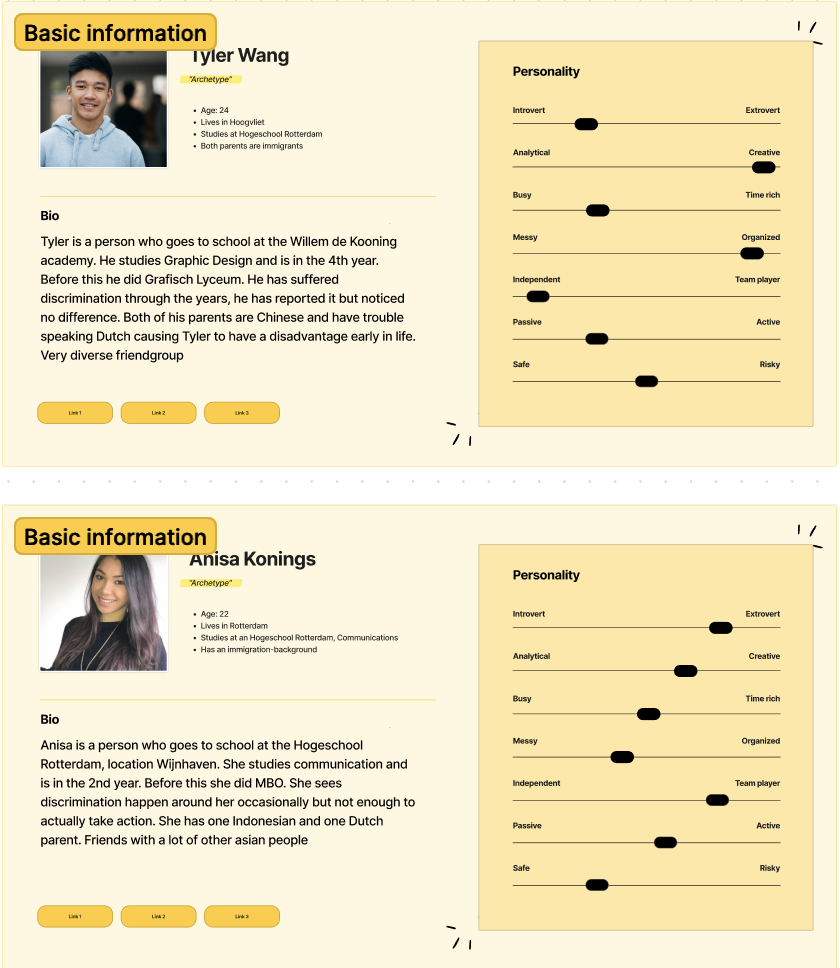
After those interviews it was time to see what information we gathered. Firstly I categorized the insights into a few different statement cards. With those I created two user persona's along with two empathy maps.
How did we react?
To find a solution to the aforementioned problems we held a brainstormsession. In which we used various methods of generating ideas; such as brainwriting and a wordweb.
With a few ideas to build off of we started working on a prototype that we could present to the teachers.
For the prototype we started working on posters, a digital prototype and flyers. Along with a presentation about our journey and the concept.
Results
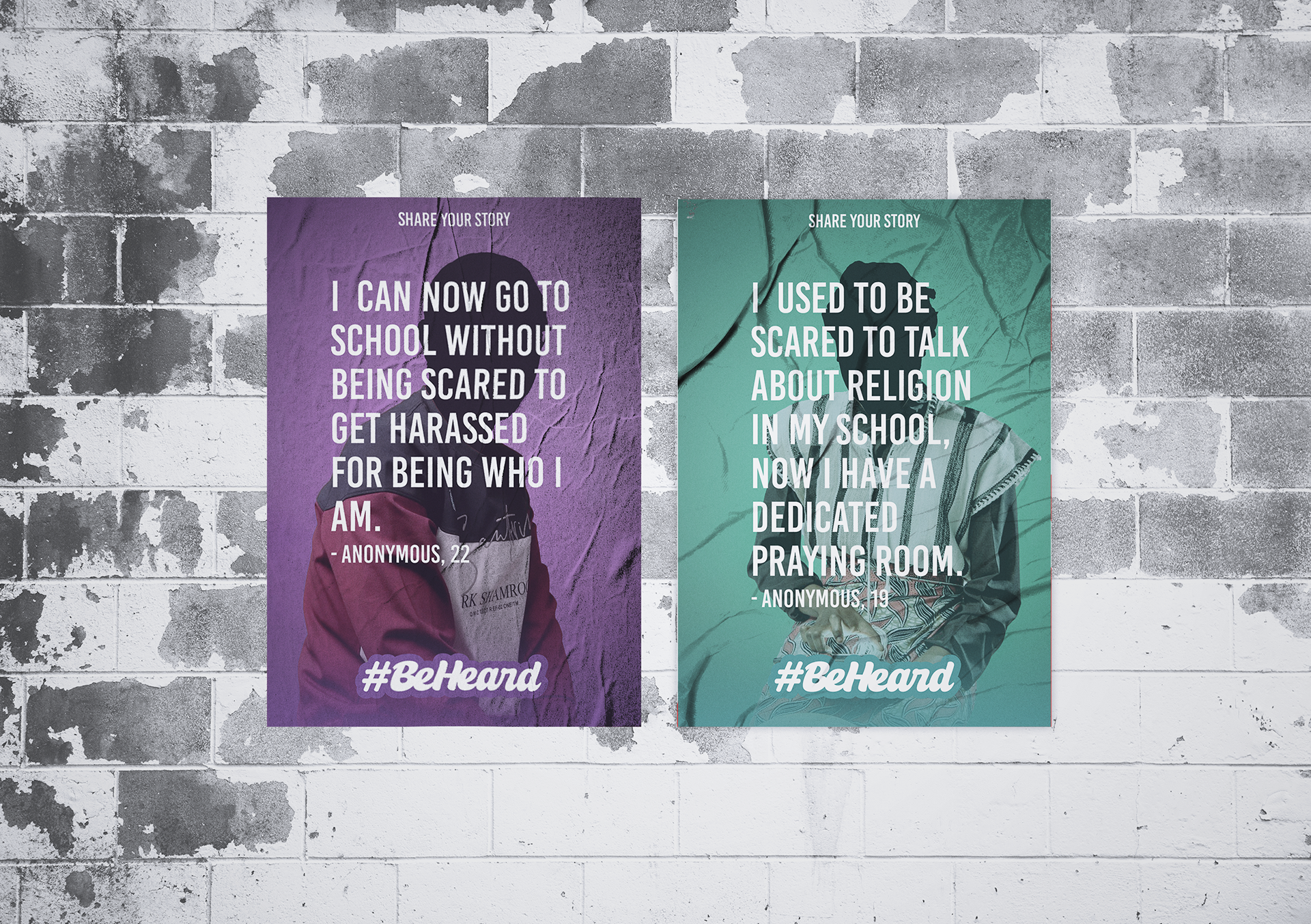
#BeHeard is a campaign aimed at spreading awareness of social injustices in the school system. On several big screens along the school there will be anonymous testimonies from students who have reported incidents of discrimination. The 'succes stories' are meant to encourage people in similar situations to speak up about their experiences.
The campaign comes with a temporary exposition in which passerby's can tell their stories, which in turn get added to the screens. There will be a interactive board where a user can click through all these stories.
View the figma prototype


Home
Work
About me
Contact
Blended and intensive program
Cultural diversity in a digital city
Project type
International project
Time period
Mar. 2024 - Mar. 2024 (1 week in person)
Group composition
Team of 6 (2 Portuguese students, 2 Finnish students, 1 other Dutch student)
My role
Visual lead, Interaction designer, prototyper, ux designer, researcher.
Context
The Blended Intensive Program; Smart Inclusion and Value Senstivie Design, or the BIP. Is a programme that is jointly coordinated by Hogeschool Rotterdam, UAS Metropolia (Finland) and IPCA (Portugal). The goal of the programme is to delve into the dynamic challenges faced by modern cities. Each group consists of 6 students, 2 from each country, who get to decide their own 'How might we...' question.
Today, over 50% of the global population resides in urban areas, with projections indicating a rise to 70% by 2050. Once a city is built, it is hard to change. This poses challenges in altering land use, infrastructure, transport systems, and housing arrangements. Given the crucial role that cities play in addressing climate change, a substantial challenge emerges in enhancing the sustainability, livability, and inclusivity of urban life.
How might we create a save enviroment for teenagers of a cultural background to gain awareness of discrimination in schools and encourage them to speak up?
Altered question for our project
Our research has indicated that multiculturalism in Rotterdam is higher than any other city in the Netherlands. This causes cultural differences in values which can lead to discriminitation, especially in schools. Our goal was to create a save enviroment for these students to speak up.
Getting to know our audience
To get to know our target audience better, we went outside to interview students at the Hogeschool Rotterdam and the Willem de Kooning academy. Quickly we found out it is very hard to interview people about such a sensitive topic, and not everybody in the team felt comfortable with doing so. As a solution a few teammembers, including me kept interviewing a few people and the rest of the team set out to create a survey.
Our insights
Our insights
After those interviews it was time to see what information we gathered. Firstly I categorized the insights into a few different statement cards. With those I created two user persona's along with two empathy maps.
How did we react?
To find a solution to the aforementioned problems we held a brainstormsession. In which we used various methods of generating ideas; such as brainwriting and a wordweb.
With a few ideas to build off of we started working on a prototype that we could present to the teachers.
For the prototype we started working on posters, a digital prototype and flyers. Along with a presentation about our journey and the concept.
Results
#BeHeard is a campaign aimed at spreading awareness of social injustices in the school system. On several big screens along the school there will be anonymous testimonies from students who have reported incidents of discrimination. The 'succes stories' are meant to encourage people in similar situations to speak up about their experiences.
The campaign comes with a temporary exposition in which passerby's can tell their stories, which in turn get added to the screens. There will be a interactive board where a user can click through all these stories.
View the figma prototype
